
What is Fill rate / Fulfilment rate?
Fill rate is the percentage of retailer demand being fulfilled by the channel partner. In mathematical terms, it is the percentage of the ordered quantity that gets delivered to the retailer/customer.
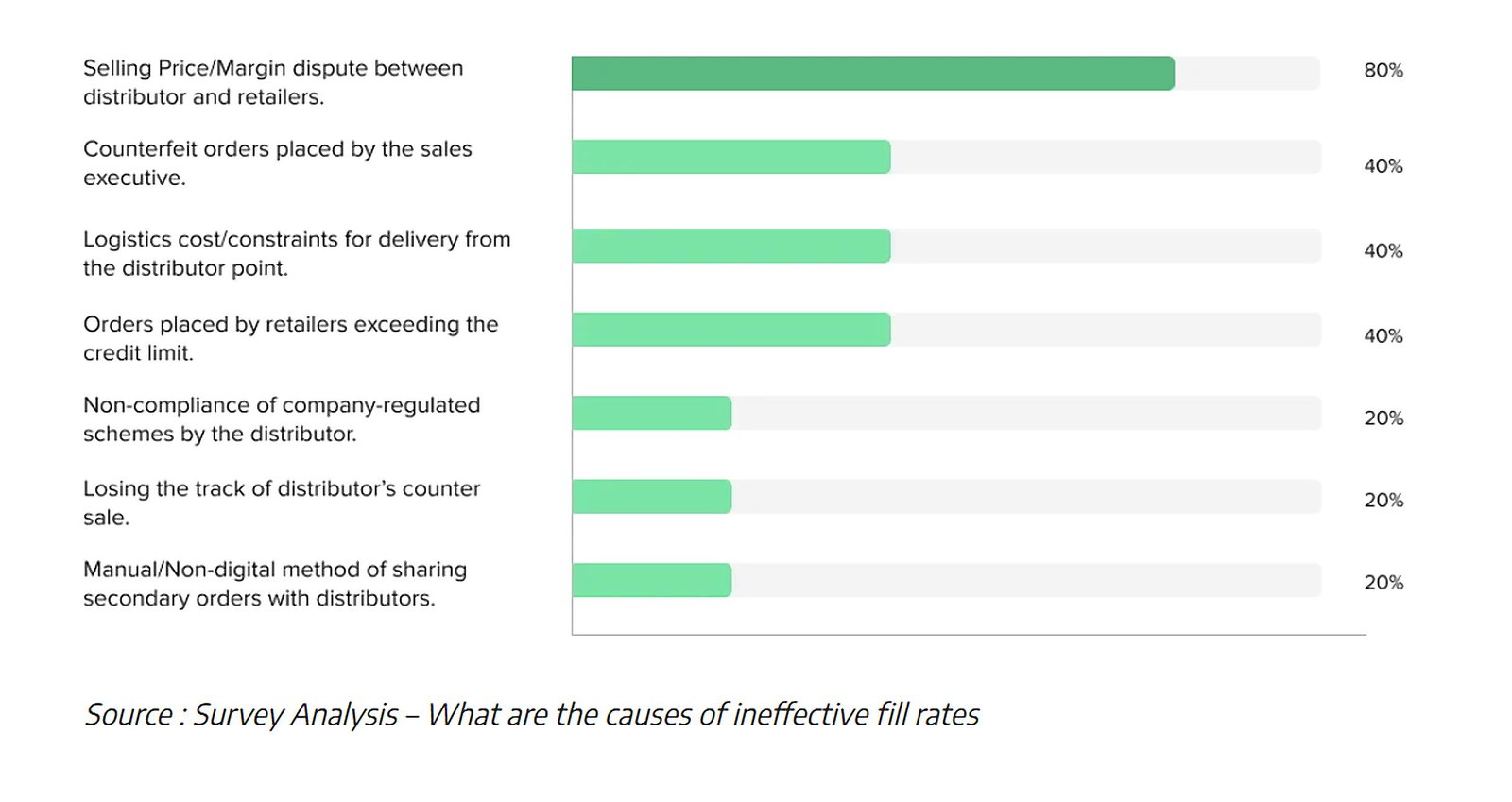
What are the causes of ineffective fill rates?
- Manual / non-digital method of sharing secondary orders with distributors.
- Orders placed by retailers exceeding the credit limit.
- Losing the track of distributor's counter sale.
- Selling price / margin dispute between distributor and retailers.
- Counterfeit orders placed by the sales executive.
- Non-compliance of company-regulated schemes by the distributor.
- Logistics cost / constraints for delivery from the distributor point.
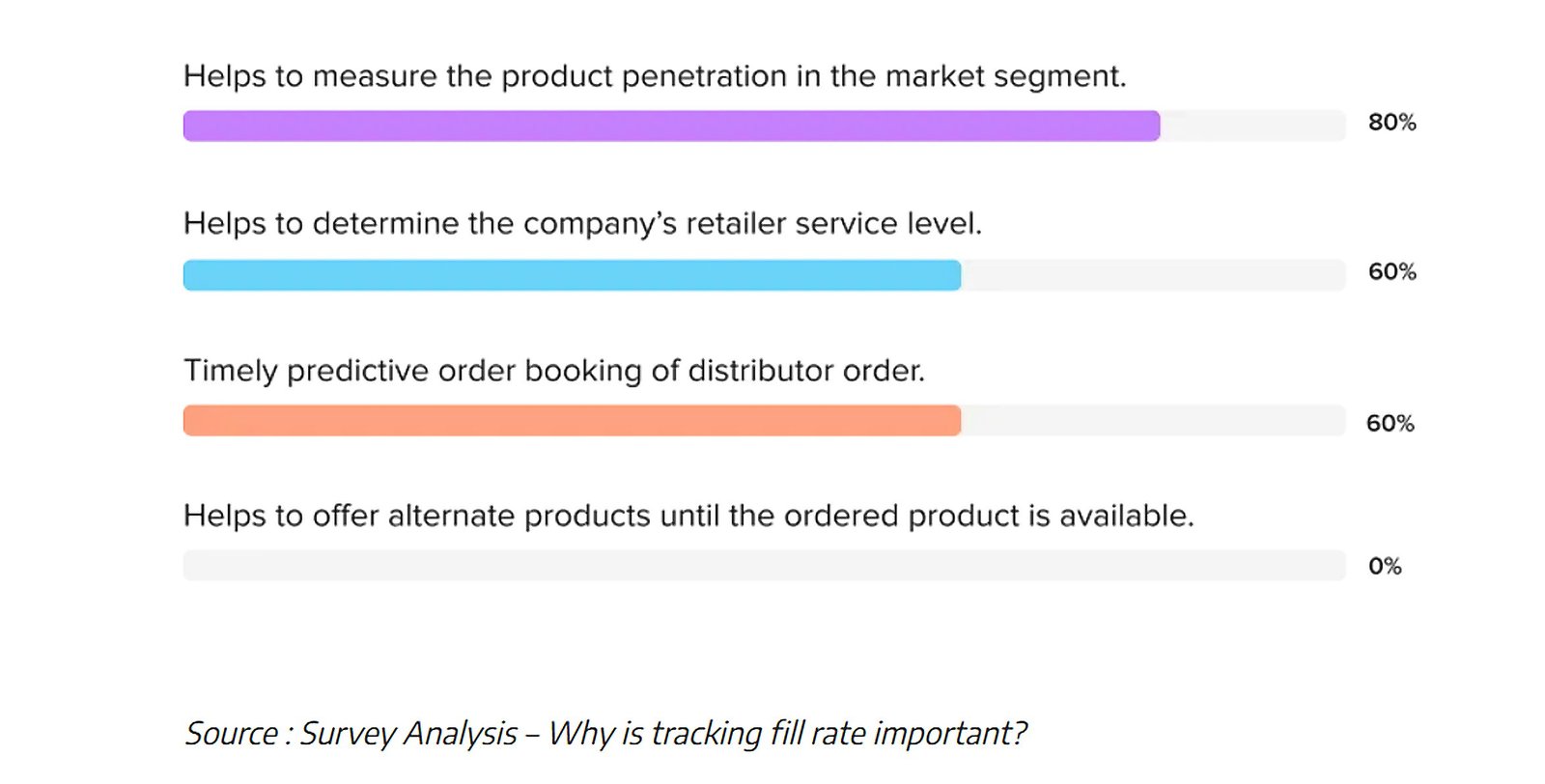
Why is tracking fill rate important?
- Helps measure product penetration in the market segment.
- Helps offer alternate products until the ordered product is available.
- Helps determine the company's retailer service level.
- Enables timely predictive order booking of distributor orders.
What are the challenges in tracking fill rate?
- Usage of independent 3rd party billing software by multi-brand distributors.
- Distributor counter sales data unavailability.
- Secondary order details not being shared with the distributor digitally.
What are the possible mitigation / solutions?
1. Distributor Management System
Implementation of DMS can predominantly help a company track Primary Orders and Delivery, Secondary Orders and Delivery, Distributor self-sale, easy inventory monitoring, and improved regulatory compliance. However, companies emerging newly in the market would channelise the sale via multi-brand distributors. Distributor willingness, profitability and ROI of time are equally important for the adoption of the DMS system. In some cases the company might need to regulate some incentives policy for the adherence of the process.
2. Recording delivery status with digital proof / Goods received note by the field salesman
3. Live stock visibility of the distributor while placing any retailer order
Capturing the distributor's floor stock and helping to keep an eye on the supplier stock while taking secondary orders. Delivered primary orders placed by the distributor get added up in the current stock and delivered secondary orders get reduced from the current stock.
In some cases, the company can restrict secondary order taking if the supplier stock displays as NULL.
4. Restricting retailers exceeding credit limits from placing any order
Restrict placing any order for retailers which have current outstanding beyond the credit limit of the distributor.
5. Instant order sharing with distributors
Sharing the secondary sales orders instantly with the distributor via email / WhatsApp / message. That helps the distributor ensure that he has sufficient stock while delivering the order. In some ways it helps the distributor to allow a sufficient amount of time before the dispatch and delivery.
Manual order sharing could be delayed due to the involvement of the executive in some other sales activities. Automation has its own discipline.
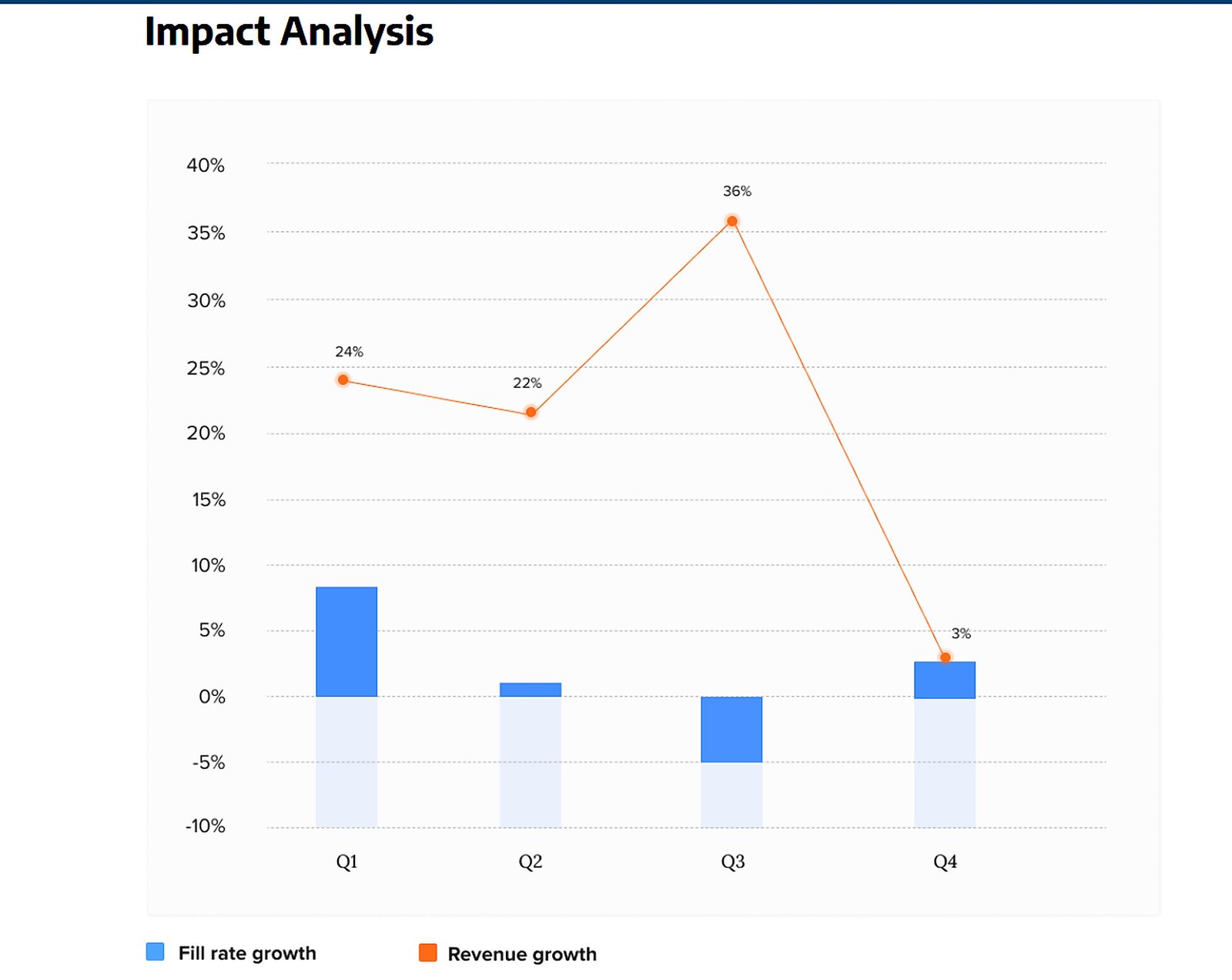
Impact Analysis
Observation: Fill rate growth is not always proportional to revenue growth. Even a slight increase (1%) in fill rate in Q2 boosted the sales growth (by quantity) by 22%. Even in Q3, when the fill rate got dipped by 5%, the sales growth (by quantity) got increased by 36%.
Total quarterly primary sales increased from 20,060,944 units (Quarter 0) to 42,923,193 units (Quarter 4) with a Q-O-Q growth rate of 24%, 22%, 36%, and 3%.
Conclusion
Companies that monitor fill rates tend to have a higher opportunity to boost sales revenue. Monitoring the fill rate cannot be done only by implementing DMS but also by various features demonstrated above. It also helps the companies to understand the root cause behind low fill rate (in case) and mitigate the challenges.
How SalesDiary can help?
SalesDiary helps companies to implement a Distributor Management System. The system is agile to be integrated with any 3rd party billing software by exposing our APIs.
Since implementation of DMS has its own challenges:
- Distributor willingness to adopt a new system — including a lack of capital and manpower.
- Multi-brand FMCG distributors can be reluctant to use different DMS for different brands.
- Struggle with unreliable electricity and internet connectivity especially in rural / semi-urban areas.
- Lack of interest to comply with the company policy. It can be related to product selling in defined territories or pricing as well.
SalesDiary provides the solution by uploading the Goods Received Notes (GRN) while marking previous order delivery, setting up the credit limits of the outlets, and restricting sales executives to punch orders for retailers exceeding the credit limit.
SalesDiary also enables capturing the payment made by retailers by different modes like cash, cheque, UPI. It also helps sales executives keep track of distributor stock while placing any orders. In case of counterfeit outlets (if created by any salesman), SalesDiary enables the supervisors to verify the outlets.