Modern Trade has been seeing tremendous growth over the years, especially for FMCGs. With a tremendous and steady shift from general trade to modern trade, companies are focusing on generating more revenue from Modern Trade Outlets (MTOs).
According to a Financial Express article, from Q3 2016 to Q3 2018, traditional trade grew at only 2% while modern trade grew at a whopping 23%. Modern trade growth: 18% from metros, 32% from 5-10 lakh towns, 33% from 1-5 lakh towns and 58% from less than 1 lakh towns.
In 2017-18, Avenue Supermarts Ltd (DMart) added 24 stores, taking its total count to 155.
General Trade vs Modern Trade
Ownership
- General Trade: Store is owned by an individual, with limited space capacity.
- Modern Trade: Store is owned / franchised by a multinational / privately held company with a standard set of processes controlled centrally and comes with large space availability for brand visibility.
Terms of Trade (TOT)
- General Trade: Margin structure of each product is decided by the company policy or by the distributor of the product. Trade promotions may be offered by sales representatives.
- Modern Trade: The production company and the retail chain purchase division enter into an annual trade agreement — including minimum purchase quantity, volume purchase discounts, % of shelf space, and activities to be carried out as part of merchandising.
Supply Chain
- General Trade: The salesman goes to the shop on a regular basis, takes the order, and the distributor supplies the same day or week.
- Modern Trade: Order generated at the HQ purchase manager and directly sent to the sale / division head; the company mostly decides to supply from its own central / regional warehouses.
Brand Visibility
- General Trade: The salesman goes to the shop on a regular basis, takes the order and the distributor supplies the same on the same day or the same week.
- Modern Trade: Order generated at the HQ purchase manager and directly sends to the sale / division head; the company mostly decides to supply from its own central / regional warehouses.
How MTO Operations Work
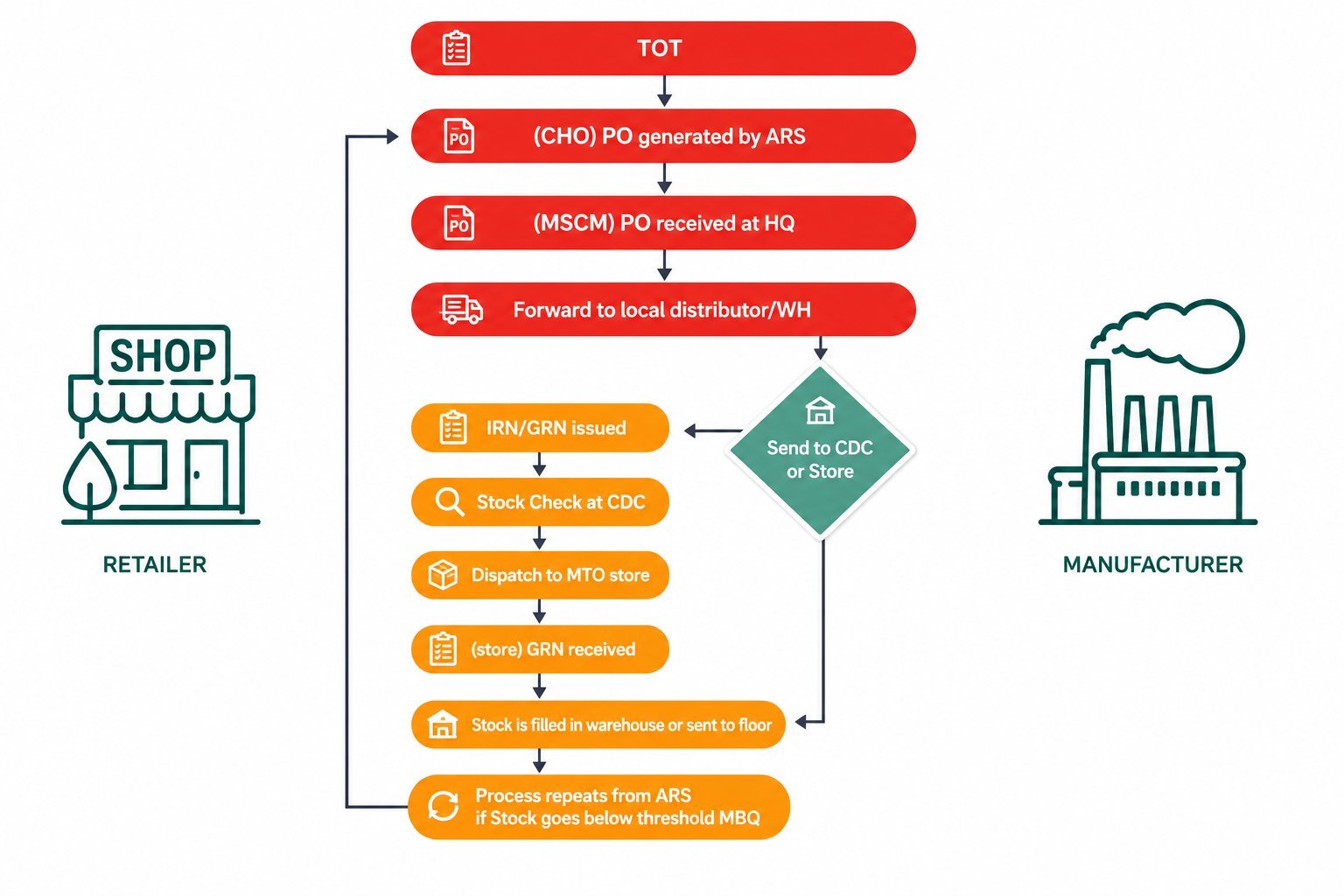
- 1Terms of trade agreement between manufacturing company and retailer — product name, minimum stock quantity, margins, customer schemes, schemes and discounts, off-take activities.
- 2Place the purchase order sent from retail HQ to manufacturer HQ mentioning the outlet location or centralized retail warehouse.
- 3Supplier MTO manager receives the PO and forwards it to company-owned warehouse or distributor.
- 4Distributor supplies the products and creates an invoice.
- 5Retailer acknowledges the goods received with GRN (Goods Received Note).
- 6Company merchandiser showcases the product to increase the off-take.
- 7If the available stock goes below the threshold MBQ, the purchase manager releases the PO.
Steps to ensure merchandising solution
- Attendance check as per journey plan — check the attendance of your sales team and verify if it is as per journey plan.
- Delivery check option as per last PO or Indent — since MTOs eliminate the need for a distributor, you should be able to check if delivery has been made in accordance with the PO.
- Check Primary Axis Point — measure the number of SKUs, share of facing, share of shelf, level of facing for both self and competitors' products, freshness of relevant products against Minimum Basic Quantity.
- Check Secondary Axis Point — check for FSU, PSU, Gondolas, Bins, End Caps, Parasites etc. which might impact tertiary sales.
- Check Tertiary Axis Point — check backroom stock. When stock is required, the sales representative should be able to immediately meet the requirement.
How Sales Force Automation Helps
- 1Creates brand visibility — in MTOs the merchandiser replaces the salesman; automation helps the merchandiser stay in line with competition with real-time updates.
- 2Increases tertiary sales — the appointed salesman provides concrete data and updates in the automation app; the sales team can be proactive across all outlets.
- 3Helps in stock checking — real-time stock updates help ensure no missing stocks and control over inventory across MTOs.
- 4Stay in line with Planogram — automation helps the sales team achieve targets accurately and efficiently by reducing unproductive hours on reporting.
- 5Capture product expiry date on shelf — SalesDiary lets you do ageing analysis from one single place.
- 6Define promotion calendar for the year — track schemes and offers to be given to various outlets, product-wise or outlet-wise.
- 7Monitor sales — monitor sales achieved and compare against your investment for shelf rentals.
- 8Capture competitor — benchmark your activities against competitors in each outlet.
SalesDiary advanced features for Modern Trade
- 1Route Management: Optimize routes based on priority outlets and business goals.
- 2Check-in and Check-out: Geo-tagged and time-stamped records to analyse BTL activities and impact.
- 3Automated Order Generation: Reduce time on taking orders with system-suggested orders.
- 4Dispatch and Delivery Confirmation: Track and verify past orders with real-time updates from depot.
- 5Tertiary Sales: Enable modern retail merchandisers to record sales and consumer feedback.
- 6Consumer surveys and competition analysis: Stay abreast about market trends and new products.
- 7Customer Issues: Easily record claims, returns, damages or product feedback through the app.
- 8Team Performance: Analyse team activities and derive best practices.
From the above, it is clear that Sales Force Automation helps you remain in line with the industry — and in fact can give you an edge against your competitors.