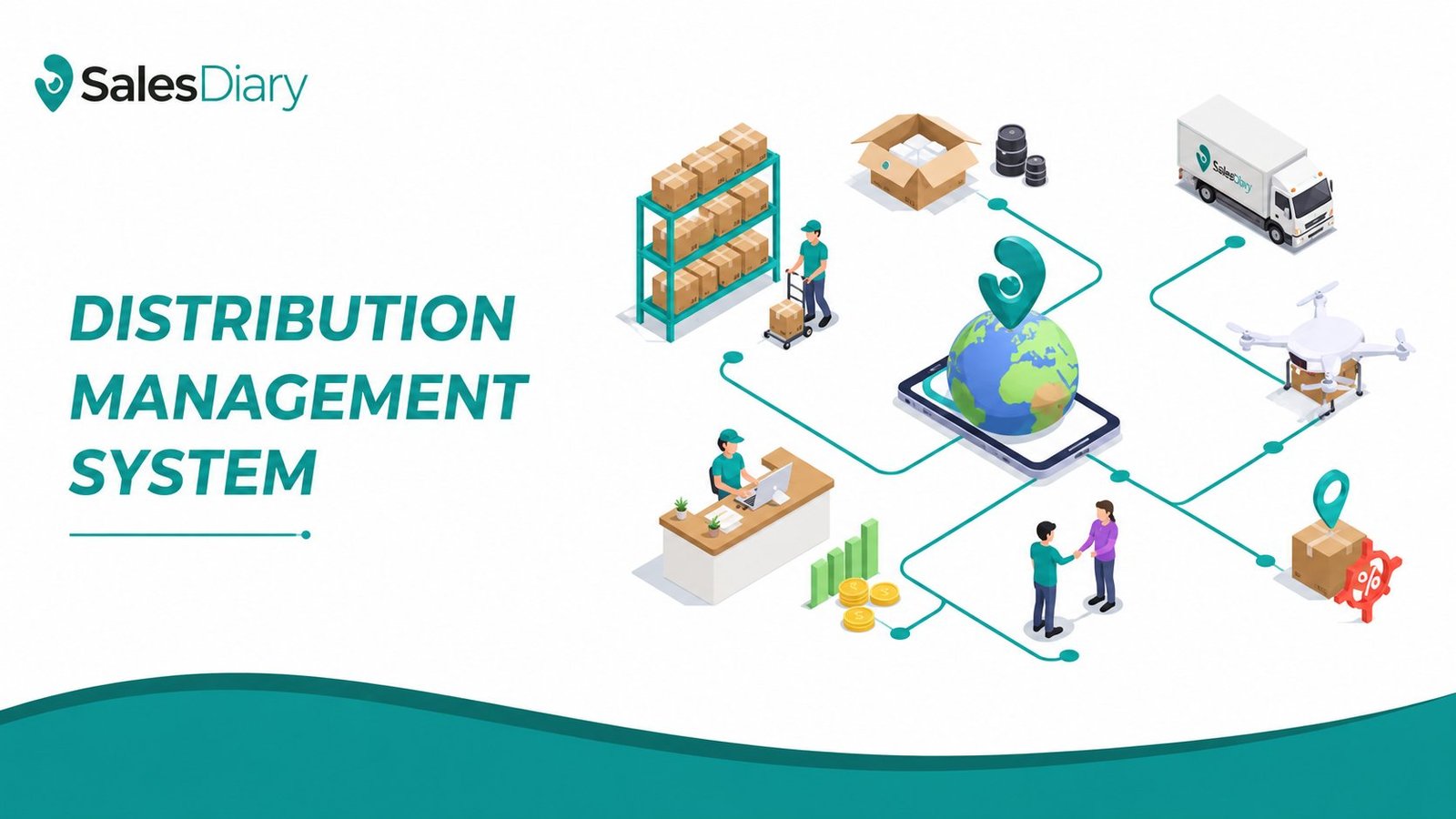
Waiting for goods on a dock in the dead of night and shivering like a leaf as the time ticks away — that's how those hardy traders started their journey and have evolved into 21st century wholesale distributors. With over 600,000 distributors in India generating $6.5 trillion in annual revenue, recent studies show wholesale distribution contributes 6% to the nation's overall GDP.
Time has proven that a good sales background alone will not contribute to success in wholesale distribution. Operational skills are another factor that fills the space for a smooth flow of the distribution process. The key here is to pick the next hot item, operate efficiently, and transform the goods stocked quickly into profit.
Why distribution channel?
With the product in one place and the retailers scattered in many areas, there is a huge space between the manufacturer and the retailers. Think about a situation where a manufacturer has to deal with orders from over 14 million outlets and the retailers have to expect the delivery from different manufacturers where hundreds of trucks line up outside the outlet every day.
If the manufacturer goes for their own outlets, then they are placing an axe on customer convenience (customers have to visit multiple outlets to satisfy their needs) and also manufacturers will lose focus from their primary responsibilities.
Hence distribution channel serves as an integral part of a supply chain in connecting between the manufacturer and retailers.
Role of distribution channel
A distribution channel fills the gap between the manufacturer and retailers. So the products can be delivered from producers to retailers and thereby to the consumer at the right time.
A distributor places the order to the manufacturer in advance, stocks the products in the distribution warehouse, and on-demand the products are delivered straight away to the outlet. The process works as follows:
- Choose the product and place the order to the manufacturer
- Stock the products
- Implement the pricing strategy
- Categorise the retailers based on maximum product reach
- Setting up credit and schemes for retailers
- Take order from retailers and deliver the products
- Collection of outstanding payments
- Dealing with expired and damaged goods
- Monitoring the entire financial flow to ensure smooth business process
Challenges faced in a distribution channel
Inability to forecast demand fluctuation
Distributors often end up with too many items that don't sell and very few items that do. This fact confirms that the term "higher stocks and periodic shortage" is not a contradiction. Underestimating product demand results in sales slipping through your fingers due to understock. In another case the distributor is left with overstock — resulting in financial drain.
Only 10% of distributors in India understand the importance of demand forecasting; the rest rely on the blanket rule such as "four weeks safety stock for everything."
Longer replenishment gap
Due to unstructured and inefficient routine processes, most distributors constantly fail to determine the exact reorder-point for item replenishment. Since every product has a different demand rate and different replenishment delivery time, the reorder-point calculation becomes more challenging.
Consider you sold 500 'X' items for the last 120 days and it took 7, 8, 8, 10, 8 days respectively for the orders to get delivered.
Reorder point = (average daily usage × average delivery time) + safety stock
= (500/120 × (7+8+8+10+8)/5) + 6 = (4 × 8) + 6 = 38
Failure to keep on-time delivery promises
Studies show that over 60% of loads that are picked up on time are delivered late. 11 shop outlets for every 1,000 people in India indicates that the old-age tactics of delivering goods will no longer serve the purpose. Major challenges include:
- Inefficiency to cover up maximum outlets
- Less capable of delivering goods based on priority
- Improper planning on outlet visit frequency
- Poor technology to track the delivery route
- Improper handling of unexpected situations like vehicle breakdown, driver on leave
Lower profit margins
According to studies, over 75% of distributors in India are leaking from 1.0 to 3.0 margin points due to improper pricing methodologies. Key contributors include not considering competition, poor knowledge about target groups, and lack of historical pricing data.
Longer claim turnaround time and fake claims
Distributors are searching in the dark when it comes to claim settlement, which results in longer claim turnaround time for retailers. This longer settlement process can lead to a fracture in the relationship with retailers.
Using Distribution Management System (DMS) for distribution practices
Perfect Order Fulfilment
The journey of a distributor starts with the mission of achieving perfect order fulfilment. With DMS, distributors get real-time stock information, AI-powered demand forecasting, faster order processing and on-time delivery — and can keep track of stock data such as quantity available, product demand and average daily usage, information about damaged and expired goods, and average delivery time for each manufacturer.
Higher profit margins with dynamic pricing and targeted schemes
DMS's dynamic pricing strategy can play a significant role in pricing decisions. It can weigh accurately how many customers are willing to pay for a product and its demand. With DMS you can segment retailers based on performance, buying potential, etc. — and target the exact retailers for the scheme tailored.
Efficient claim approval and settlement process
With DMS you can set clearly defined service level agreement policy with retailers. This includes claim turnaround time, deadline to raise the claim, accuracy of claims, percentage of claims with no evidence. Data integrity check and algorithmic calculations ensure claims are calculated correctly.
Benefits of DMS — at a glance
- Order Management: Accurate data-driven order placing, proper replenishment gap, higher order fulfillment, fewer order returns, lower operational cost
- Inventory Management: Perfect demand forecasting, real-time stock information, data-driven classification of inventory
- Pricing & Scheme Management: Dynamic pricing strategy, customised schemes, centralised pricing and scheme system, multi-scheme combinations
- Dispatch & Delivery Management: Efficient route planning and optimisation, data-driven route assignment, real-time tracking and deviation alerts
- Payments & Outstanding Management: Bulk invoice generation, track outstanding payments, set automatic reminders
- Claim Management: Agreement policy set up, efficient claim approval and settlement process
- Tally Synchronized: Centralised data, easiness in import/export, real-time synchronization
- Tax Compliance: Invoice management, simplified tax filing and notifications, receivable tracking and alerts
- BI Tools: Easy report rebuilder, interactive dashboard elements, customisable
DMS impact on your ROI
| Revenue Increase | Cost Reduction | |
|---|---|---|
| Order Management | 99% faster order fulfilment, 35% increase in order frequency | 91% decrease in operational cost, 99% decrease in order errors |
| Inventory Management | 80% increase in product availability, greater visibility of supply | 40% decrease in rationalized network cost, 30% reduction in leveraged freight procurement, 18% reduction in future capex spend |
| Delivery Management | 90% increase in on-time delivery, 70% increase in frequency of retail visit | 70% reduction in delivery cost |
The biggest challenge faced by the distribution sector today is poor distribution strategy despite the outstanding expertise in sales. This failure is mainly due to the lack of operational skills. With a proper Distribution Management System, a sales expert can overcome their inefficiency in operational skills.